
The previous article, Fifteen Minutes, One Line, gathered the research behind a single line written every quarter-hour. This one steps back from the evidence to look at the object itself, and at why its pieces, once assembled, form a new art.
Two arts that never met
Around 1680, watchmakers taught a watch to strike the time on demand. When Edward Barlow announced a repeating watch in London in 1687, Daniel Quare contested the invention, and both watches were put before King James II. Quare's struck the hour and the quarter with a single push, the form that became the standard.[1] In 1783 Abraham-Louis Breguet replaced the repeater's bell with a gong spring, and repeating watches grew slimmer.[2]
In the same century, in the Jura mountains, watchmakers were building androids that wrote, drew and played music.[3] Between 1768 and 1774, Pierre Jaquet-Droz, his son Henri-Louis and Jean-Frédéric Leschot completed three of them. The most complex, the Writer, is a seated boy of some 6,000 parts who dips a goose quill in ink and writes any text of up to forty letters, chosen in advance on a wheel.[4]
One art gave time a voice. The other gave a machine a hand that writes. In 2020 UNESCO inscribed them together, mechanical watchmaking and the art mechanics of automata and music boxes, as a single living heritage where science, art and technology meet.[5] They shared workshops, families and mountains, but never a single gesture.
The work, piece by piece
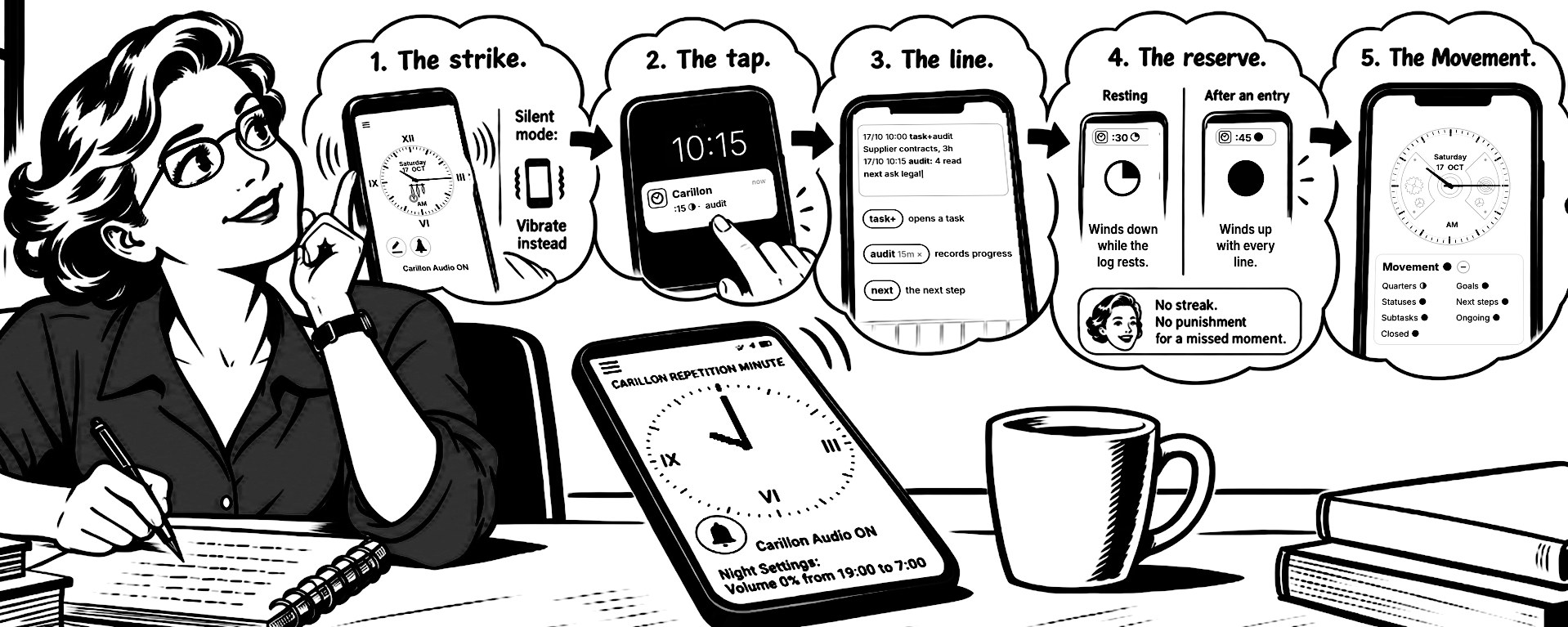
Carillon Repetition Minute brings the two together, and its name already holds both halves: the carillon, the art of making music with bells,[6] and the répétition minutes, the watch that sounds the time on request.
Taken in the order a user meets them, the pieces run as follows:
- The strike. The quarters and the hours sound on their own, and a press of the dial strikes the full time, as a minute repeater does. In silence, a vibration takes its place.
- The tap. In the full version, each strike arrives as a notification that can carry the name of the task in hand, and one tap opens the logbook.
- The line. One sentence, typed or spoken, says what the quarter held. A light grammar, "task+" to open a task, its label to record progress, "next" for the step that follows, keeps every line easy to read back.
- The reserve. A small dial on each notification, modelled on the power-reserve indicator of a mechanical watch, winds down while the logbook rests and winds up with every line. It keeps no streak and makes no reproach; missing a single opportunity does not derail a forming habit.[7]
- The Movement. Gauges on the summary page show how often the logbook is actually kept, so the pace can rise as the habit settles.
Several of these words come from the watchmaker's bench: repeater, power reserve, movement. In watchmaking, a complication is any function beyond telling the hours and minutes. This one is a complication no watch case could hold: a written memory of the day.
Why call it art
The Greeks used one word, technē, for the skill of the craftsman and for the fine arts, as Heidegger reminded the twentieth century.[8] Donald Knuth claimed the same dignity for software in his 1974 Turing Award lecture: programming is an art because it demands skill and ingenuity, and above all because it can produce objects of beauty.[9]
John Dewey moved art from the object to the experience: the work, he argued, is what the object does in a person's life, not the thing on the shelf.[10] Marcel Duchamp took the next step in 1957. For him the creative act is never the artist's alone: those who receive the work add their own contribution, and they decide its weight.[11]
That is precisely how this instrument works. The strike, the tap, the reserve and the gauges are the same for everyone. The work they produce is not: each logbook is written by its owner, quarter after quarter, and no two are alike. Allan Kaprow spent decades arguing for art that blurs into everyday life,[12] and Nicolas Bourriaud described artworks that act as "ways of living and models of action".[13] A quarter-hour log is a modest case of both: an art that lives inside an ordinary Tuesday.
Artists who made time their material
Time itself has been an artistic material for decades. From 1966 On Kawara painted, on a given day, nothing but that day's date, and for eleven years he mailed friends postcards stamped with the hour he had got up.[14] From April 1980 to April 1981 Tehching Hsieh punched a time clock in his studio every hour, on the hour, shooting one frame of film at each punch.[15] Christian Marclay's The Clock, a 24-hour montage synchronised with local time and therefore a working timepiece, won the Golden Lion in Venice in 2011.[16] Earlier still, in 1952, John Cage's 4′33″ framed a measured span of time in which the performer plays nothing, and asked the audience to listen to it.[17]
These works made time visible and audible, most of them at the cost of extraordinary discipline, and they belong to museums and concert halls. Museums have since opened their collections to software: in 2012 the Museum of Modern Art acquired its first fourteen video games as works of interaction design,[18] and in 2014 Björk's Biophilia became the first downloadable app in its collection, praised by its curator for letting people take part in making the music rather than only listening.[19]
What these works could not offer was the same frame for anyone, carried in a pocket, asking a few seconds per quarter. Hsieh's hourly punch was an act of endurance. Here the punch becomes one line, and endurance becomes habit.
What is new
Bells are old, and so are notebooks. Science, too, has long used signals that ask for a note on the spot: since the 1970s, researchers studying daily life have given people pagers that beep during the day and request an immediate entry.[20] Keeping track of progress improves the odds of reaching a goal, and more so when the progress is written down.[21]
None of these is new on its own. The novelty lies in their order, and in the single tap that joins them. Like any instrument, the result also trains the one who plays it. Attention locks onto regular rhythms and learns to anticipate them.[22] The laboratory evidence concerns rhythms of seconds, so applying it to quarter-hours is a plausible extension rather than a measured fact; if it holds, the strike slowly stops informing and starts tuning.
Art history, as George Kubler described it, moves through prime objects, the first solutions to a problem, each followed by long chains of replicas.[23] New arts are rarely new materials. They are new arrangements of old ones, and the arrangement carries its author's hand. Each piece of this one has been set down here, in dated articles, since September 2026.
The matter of the book
In 1580 Montaigne opened his Essais by warning the reader that he himself was the matter of his book.[24] With that book a new form was born, the essay: a life observed and written down in pieces, without waiting for a finished story.
The minute repeater was made so that its owner could know the hour in the dark. Its new form keeps that gift and adds a quieter question at every quarter: what was this time for? Answered one line at a time, the question writes a book whose matter is its owner. That is the new art: a watch complication that ends not in a sound, but in a page.