
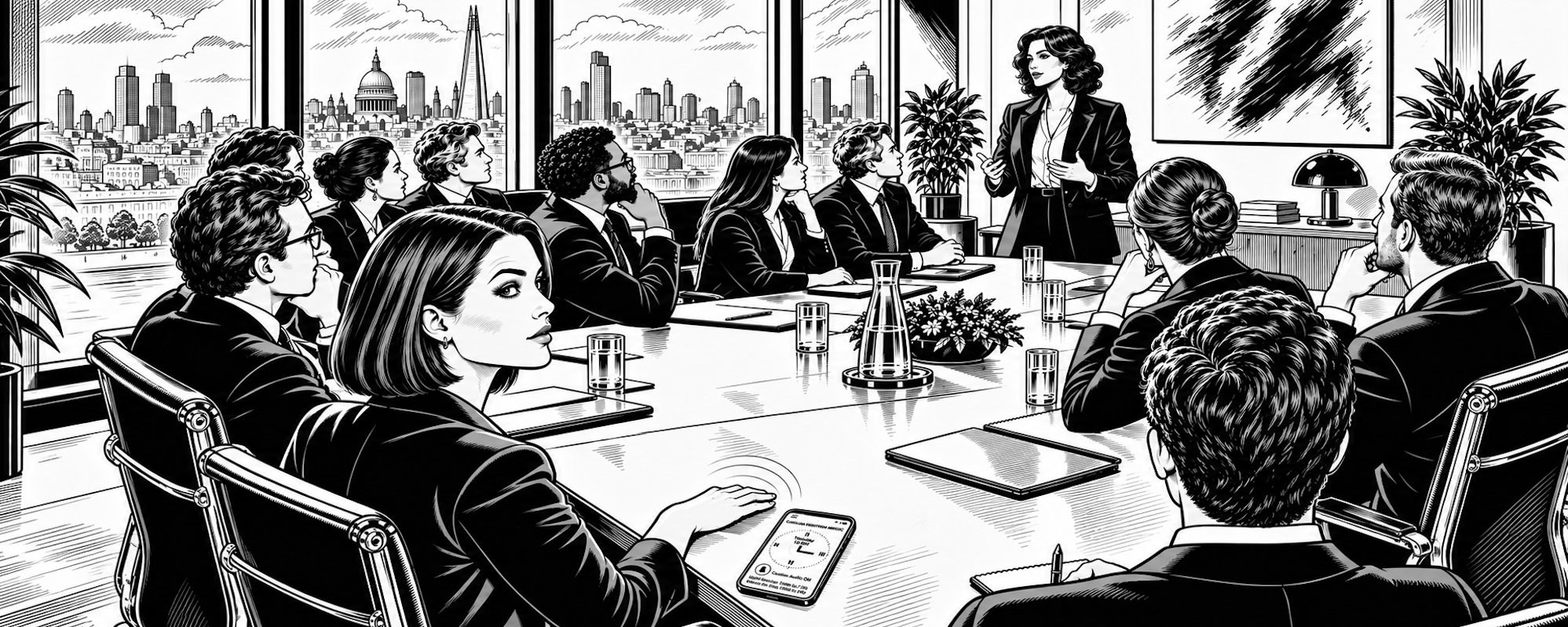
More than a century ago, management discovered the clock.
Frederick Winslow Taylor's scientific management broke work into measurable tasks. Stopwatch studies, begun in the 1880s, were used to measure, standardise and reduce the time required to perform industrial work.[1] The philosophy was straightforward: time wasted was productivity lost.
By the 1960s, management thinking had moved beyond the factory floor. Peter Drucker turned the question toward executives themselves. In The Effective Executive, he argued that managers should first record where their time actually went. His conclusion was memorable: "Time is the scarcest resource, and unless it is managed, nothing else can be managed."[2]
Then came another cycle.
Toyota developed its Production System through the 1950s and 1960s around shorter lead times, continuous improvement and, fundamentally, the elimination of waste.[3]
Decades later, the Agile Manifesto reacted against another kind of waste: heavyweight processes and excessive documentation. In 2001 its authors emphasised interaction, working results, customer collaboration and responsiveness to change.[4]
Taylor measured minutes. Toyota attacked waste. Agile attacked process.
And yet the meeting grew.
A 2017 Harvard Business Review study reported that executives were spending nearly 23 hours a week in meetings, compared with less than 10 hours in the 1960s.[5]
That is an extraordinary historical irony. While management theory spent half a century becoming more sophisticated about efficiency, senior managers more than doubled the amount of time they spent sitting together.
Perhaps this happened because the nature of work itself changed. In a factory, waste is often visible: a machine stands idle, inventory piles up, a worker waits for a component. In knowledge work, waste is much harder to see. Ten intelligent people can spend an hour in a beautifully furnished conference room, leave with no decision, and still feel that something productive happened simply because everyone was busy.
Meetings also carry a social advantage that makes them unusually difficult to eliminate. Calling a meeting looks active. Attending one looks cooperative. Declining one can look disengaged. A manager who adds another participant experiences almost no immediate penalty for doing so, because the cost is paid in fragments of somebody else's calendar. The organisation therefore accumulates meetings in much the same way that an old computer accumulates background processes: one by one, each defensible, until the whole system becomes slow.
And there is another asymmetry. The person who schedules a meeting usually experiences its value most strongly; the people invited may experience its cost most strongly. The organiser needs information, reassurance, alignment or a decision. For everyone else, the same hour may replace concentrated work that is much harder to restart. The meeting is therefore not merely a block of sixty minutes. It can also fragment the hours around it.
Digital tools did not solve this.
Microsoft's 2023 Work Trend Index found that the average Microsoft 365 user studied spent 57% of working time communicating — in meetings, email and chat — and only 43% creating. Sixty-eight percent said they lacked sufficient uninterrupted focus time. "Inefficient meetings" ranked as the number-one disruption to productivity.[6]
And the deeper problem was never simply that meetings exist. It is that meetings frequently fail to convert time into an outcome.
In a 2024 Atlassian survey of 5,000 knowledge workers, 77% said they frequently attended meetings whose result was to schedule another meeting, while 54% frequently left without clear next steps or ownership.[7]
This is what we would call corporate time-blindness.
A ten-person one-hour meeting does not feel like ten hours being consumed. To each participant it feels like only one. The cost is distributed, and therefore psychologically almost invisible.
Now AI has arrived promising another productivity revolution.
But look at what happened immediately before it. Microsoft's 2025 analysis of workplace activity described an "infinite workday": employees in its dataset were being interrupted by a meeting, email or message roughly every two minutes during core working hours.[8]
And the 2026 Work Trend Index makes the next problem clear. AI capability is advancing faster than many organisations are redesigning themselves around it: only 26% of AI users surveyed said leadership was clearly and consistently aligned on AI.[9]
So AI may make the document faster, the analysis faster, the presentation faster and the meeting summary automatic.
It can even give us back minutes.
But it gives back minutes without giving back awareness. The hour still passes unfelt; it simply passes more efficiently.
That is the recurring lesson of more than a century of management fashion. Every generation develops a new system for reducing waste. And every generation invents new forms of waste around it.
The scarce resource was never the stopwatch, the methodology, the workflow software or the AI model.
It was time.
And perhaps the most elementary management skill is therefore also the most enduring one: consciousness of time passing , your own, and everybody else's.
The instrument
Every one of those revolutions produced an instrument. Taylor had the stopwatch. Toyota had the kanban card. Agile had the standup and the board. The instrument was never the argument. It was what made the argument impossible to ignore at the moment it mattered.
Corporate time-blindness has not yet had its instrument. Dashboards report time after it is spent. Calendars announce it before. Neither does anything in the twenty-third minute, when a meeting has quietly stopped converting time into an outcome and nobody in the room can feel it happening.
There is a much older answer to precisely this problem. The repeating watch was invented in 1680, so that its owner could establish the hour without consulting a dial, by pressing a pin and listening.[10] It remains the only timekeeping instrument ever designed to be heard rather than seen: made for the dark, and for company, and for not breaking the conversation.
That distinction is not decorative. In a meeting nobody looks at the clock, partly because looking is a small rudeness, and partly because looking registers nothing: a glance is a private fact. A chime is not. It is heard by everyone at once, it costs no one their attention, and it turns elapsed time from something each person estimates alone into something the room holds in common.
Our interest here is declared. We build Carillon Repetition Minute, a free background application that sounds the hours and the quarters in the manner of a repeating watch. We have spent a long time thinking about where the hours go because we built something that marks them.