
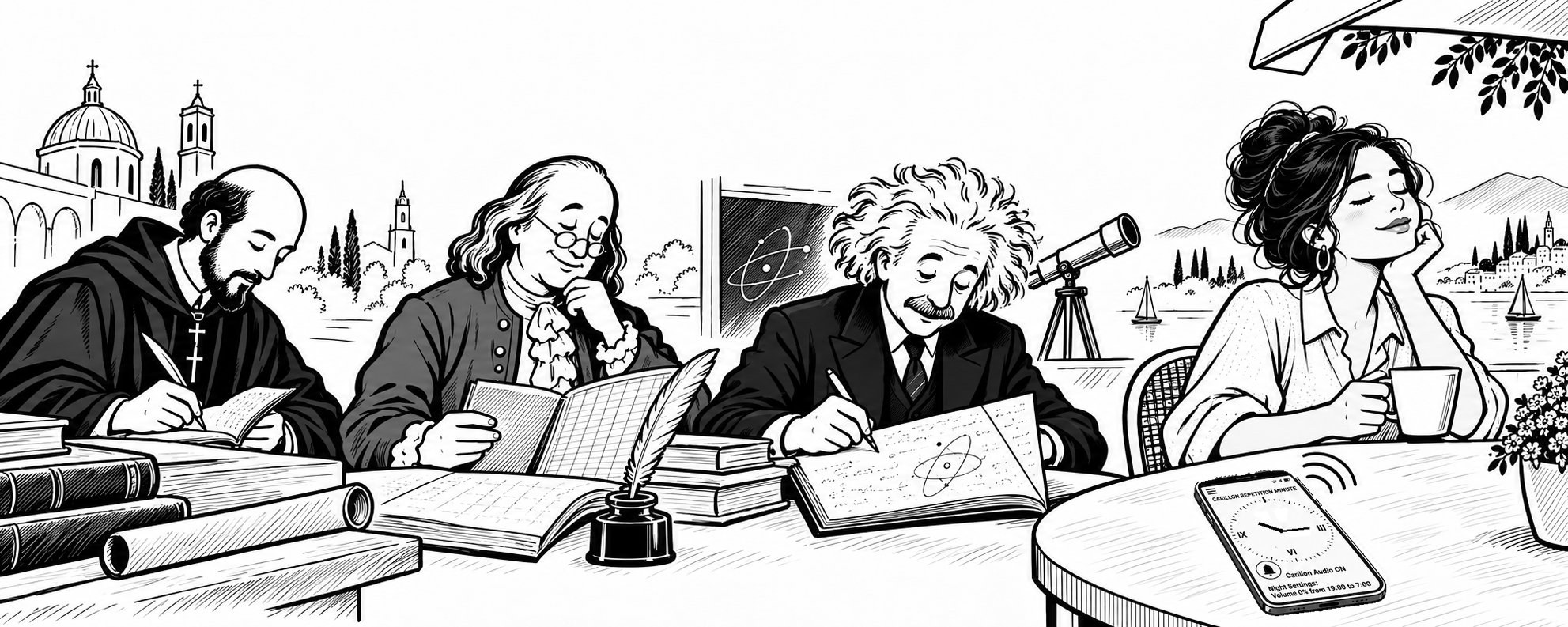
Your phone strikes the quarter. You tap the notification, say one sentence, and the last fifteen minutes are on the record.
That is the logbook in the full version of Carillon Repetition Minute. Every chime arrives as a notification, and the notification is the door: one tap opens the log, already waiting for you. Type if you like. Or touch the microphone on your keyboard and simply talk: the keyboard transcribes, and the entry writes itself. No app to find, no page to open, no pen.
Today’s high achievers will love it, for one reason: a journal has always demanded a quiet hour, and this one asks for a few seconds.
But why would an app that chimes like a minute-repeater watch keep a journal?
Because a logbook is the exact opposite of time blindness. Time blindness is a day that passes without being felt and ends without leaving evidence. The chime makes you hear time pass. The line you leave behind shows you where it went.
None of this is new. It was discovered slowly, over five hundred years, by people whose names you know. This is the history of that discovery.
The previous article, "You Already Have a Longevity Project", ended with a quarter of an hour that had just finished and a short note about it. This one looks at the people who took that idea furthest, long before anyone thought to test it.
The history nobody shows you
History introduces extraordinary people through what they accomplished. Leonardo painted the Mona Lisa. Darwin gave us natural selection. Einstein transformed physics. We meet them at the end, once uncertainty has disappeared. Behind the achievements lies another history, less spectacular and more useful to the rest of us: pages of observations, sketches, mistakes, predictions and questions.
Their records differed, but one mechanism reappears across the centuries: observe, record, compare reality with intention, correct, continue.
Calvin: checkpoints in the day
John Calvin held that attention cannot be trusted to stay focused. In the Institutes of the Christian Religion he set fixed moments for recollection: on rising, before work, around meals, before retiring. Human “torpor”, as some translations put it, had to be stirred again and again. [1]
Strip away the theology and the structure is familiar. Instead of discovering at night, or years later, that actions have drifted from intentions, the day itself contains moments at which direction can be restored.
Ignatius: self-examination becomes a record
Saint Ignatius of Loyola went further. In the Spiritual Exercises, the practitioner chooses one fault in the morning, then reviews the day “hour by hour, or period by period”, marking each occurrence with a dot on a line. The two halves of the day are compared and the intention renewed. [2] His General Examen follows the same logic, reconstructing the day from rising to the present moment before deciding what should change. [3]
Choose a target, observe, record, compare, adjust. Centuries before habit trackers, Ignatius had found something remarkably modern: memory becomes more useful when part of it is kept outside the head.
Franklin: virtue becomes data
Two centuries later Benjamin Franklin chose thirteen virtues, ruled a little book with a line for each and a column for each day, and marked every lapse, concentrating on one virtue at a time. [4] It did not make him perfect, as he freely admitted. It made an abstraction observable.
“I should be more disciplined” is a wish. A page showing when and how often you failed is information. Once behaviour becomes information, improvement depends less on impression and more on comparison.
Leonardo: catch the thought before it disappears
From the mid-1480s Leonardo da Vinci filled sheets with observations, diagrams, anatomy, machines and personal notes, often several unrelated ideas to a page: thought caught in motion. [5]
This is capture. An idea does not have to be complete to deserve keeping. The notebook lets an observation survive its moment; organisation and understanding can come later.
Darwin: an idea with a history
In July 1837 Charles Darwin opened his first notebook on the transmutation of species. [6] A brief sketch followed in 1842, a longer manuscript in 1844, and On the Origin of Species in 1859. [7] More than twenty years separate the notebook from the book.
A large idea rarely arrives complete. It accumulates. The notebooks let Darwin continue a conversation with the Darwin of the previous year, and they show us that the final idea was far less inevitable than it looks.
Edison: failure becomes evidence
Thomas Edison made note-taking an institution. From 1877 his laboratory kept regular records, soon in standard bound notebooks, and more than 3,000 laboratory notebooks survive. [8]
A failed experiment remembered only as a disappointment is worth little. A failed experiment accurately recorded eliminates possibilities and shapes the next attempt. The logbook prevents experience from having to be rediscovered.
Einstein: the road you rejected
Einstein’s Zurich Notebook of 1912 and 1913 shows him reaching ideas close to the mathematics general relativity would finally need, then rejecting them because they seemed to conflict with his physical expectations. [9]
The notebook preserved the wrong turn, and with it the road back. An abandoned path stays available when circumstances change.
Picasso: a masterpiece has ancestors
Picasso’s sketchbooks for Les Demoiselles d’Avignon hold study after study from 1907: figures moved, forms simplified, compositions tried and discarded. [10] The finished painting looks singular. The sketchbooks show a sequence, and the masterpiece as the surviving branch of a much larger tree.
Feynman: writing is thinking
Caltech preserves 611 pages of Richard Feynman’s working notes for his physics lectures of 1961 to 1964, including approaches he rejected. [11]
An intuition held in the mind can stay comfortably vague. Written down, it must take a form. A sentence exposes ambiguity; a calculation shows whether the idea works. The page is where thought meets resistance.
Fuller: a whole life as an experiment
Buckminster Fuller kept the Dymaxion Chronofile, a chronological record of his correspondence, manuscripts, plans and agendas that now fills some 1,200 linear feet at Stanford and lets his days be reconstructed one by one. He regarded his life as an experiment whose results should be recorded. [12]
Most of us judge our lives from memory, and memory compresses years, magnifies the unusual and quietly rewrites old intentions. A record made at the time shows where attention really went, which projects returned, and whether the work that felt productive produced anything.
Drucker gives it a name
Peter Drucker called the principle feedback analysis. Before an important decision, write down what you expect to happen; nine or twelve months later, compare. He practised it for fifteen to twenty years and said it revealed strengths and weaknesses that intuition had missed. [13]
Drucker traced the method to an unnamed fourteenth-century German theologian, and then to Calvin and Ignatius. [13] That origin story is his own attribution, not established fact. His broader point stands: humanity discovered the practice long before science discovered the mechanism.
Science finds the feedback loop
In 1948 Norbert Wiener’s Cybernetics made feedback the basic principle of regulation: a desired state, information about the actual state, a comparison, a correction. [14] A thermostat that wants 21°C achieves nothing until it knows the real temperature.
Psychology followed. Frederick Kanfer made self-observation the first step of self-directed change, [15] and Charles Carver and Michael Scheier built a control-theory model in which people compare their current state with a goal and act on the gap. [16]
goal → action → observation → comparison → correction → next action
The logbook is the external memory of that loop.
Then it was tested. A 2016 meta-analysis in Psychological Bulletin pooled 138 studies and 19,951 participants: prompting people to monitor their progress improved goal attainment, and the effect was stronger when progress was physically recorded than when it was only noticed. [17]
A notebook does not produce genius. Leonardo was not Leonardo because he owned paper. The effect is subtler: a written record captures what memory loses, exposes the gap between intention and behaviour, and stops hindsight from rewriting what we expected.
A conversation with your future self
A logbook lets different versions of the same person speak across time. The person at nine leaves information for the person at noon. This month’s expectation meets next year’s result.
It needs no fine prose: what you intended, what you did, what happened, what should change. One day is an anecdote. A week reveals habits. A year reveals direction. Several years reveal where time keeps disappearing, and whether everyday behaviour resembles the future we claim to want.
A logbook does not tell us our destiny. It shows the direction in which we are already travelling. Once that is visible, it can be corrected.
From the notebook to the pocket
Leonardo carried loose sheets. Franklin carried a little book. Edison bought bound notebooks by the hundred. We carry phones, and a thought can now be dictated while walking and found ten years later by a single word.
Capture has become effortless. But the mechanism was observe, record, compare, correct, continue, and the phone has solved only the second step. Calvin’s problem is still ours: a day carries us away from our intentions unless something interrupts it. The archive is only as good as the moments at which we stop to feed it.
That is why an app that strikes the hours keeps a logbook. The chime is Calvin’s checkpoint. The line you speak after it is Ignatius’s dot. Time blindness is a day with neither.
The next article looks at the people who work this way today.