
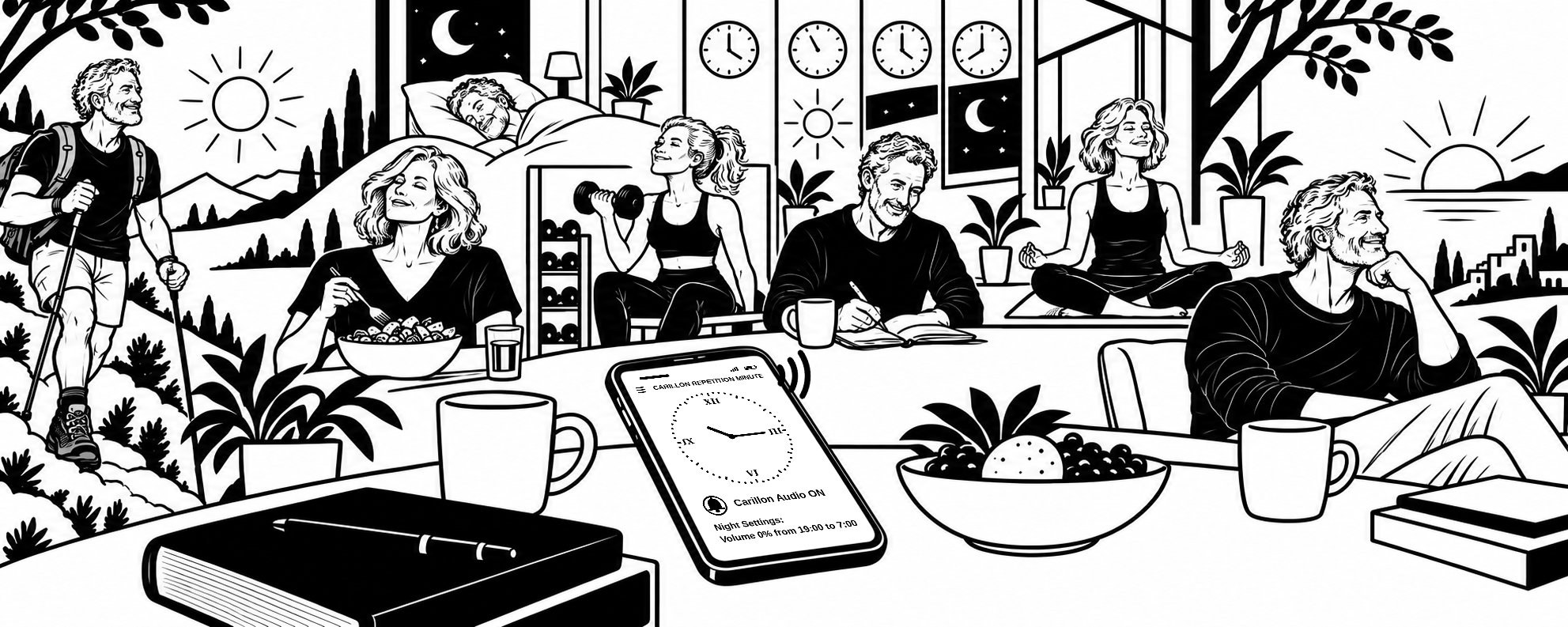
Whatever our age or our health, most of us share one quiet wish: that the time ahead of us be good time. That wish is already a longevity project.
The previous article, "Longevity: More About Time Than We Think", looked at a less-discussed corner of longevity research: regularity. Sleep, movement, meals and rest don't only have quantities; they also have a rhythm. While longevity is usually presented as a battle against biological time, perhaps part of it is simply learning to notice time again.
Following that idea further leads somewhere unexpected. Longevity starts as a health project. Sooner or later, it becomes a project about time.
One day for everything
At first, longevity looks like a list of good intentions. Sleep better. Move more. Keep our strength. Eat well. Look after blood pressure and the other numbers our doctors watch. Perhaps try fasting, sauna or supplements. Each subject comes with its own specialists, books, podcasts and devices, and each one, taken alone, seems manageable.
Then Tuesday morning arrives.
Movement needs its place in the day. Sleep needs eight hours, but it also needs a beginning. Meals have to happen. Rest needs space. An appointment runs over, a telephone call lasts longer than planned, lunch drifts from 12:30 to 14:00, and the walk meant for late afternoon quietly disappears.
All the complexity of longevity meets one very simple constraint: everything has to fit inside the same twenty-four hours.
Research has reached the same conclusion from the other direction. Physical activity, sitting and sleep are now increasingly studied together as "24-hour movement behaviours", because they are not independent of one another. They compete for the same hours.[1] Statisticians have even adopted special methods, known as compositional data analysis, precisely because an hour given to one behaviour must come from another.[2] In 2020 Canada went further, publishing the first national guidelines for adults that treat sleep, sitting and movement as a single 24-hour whole rather than three separate recommendations.[3]
It sounds almost too obvious to need science, but it changes how longevity looks. We don't really have a sleep programme, a movement programme, a nutrition programme and a daily life running side by side.
We have Tuesday.
One ordinary day, in which our health, our work, our errands and the people we love all have to find room. Every longevity plan, however sophisticated, is finally lived there, one Tuesday after another.
So what are all these Tuesdays for?
Not, in the end, a larger number. What we hope for is what fills the hours: another journey, another project, another conversation, another subject learned, another morning when we feel well enough to go somewhere interesting. The World Health Organization says almost the same thing: healthy ageing is the ability to be and do what we value.[4]
Laura Carstensen's work adds one more thought. When time feels open-ended, people tend to explore; when it feels precious, they turn towards what matters most: relationships, meaning, moments worth savouring.[5] Both are ways of living a Tuesday well.
A good Tuesday also has a shape. The previous article dwelt on a UK Biobank result: among 60,977 people, followed through more than ten million hours of accelerometer data, the regularity of sleep predicted mortality more strongly than its duration.[6] The study was observational and cannot prove that regularity lengthens life, but it suggests the body notices when the day is regular. Chronobiologists call one common disruption "social jetlag", the gap between the body's clock and the timetable life imposes on it; in around 65,000 people it was associated with higher body weight.[7]
On Tuesday, rhythm is simpler than either study: the hour we wake, the hour we eat, the hour we go to bed. 07:15, 13:45, 22:30. Look at those hours directly, and another question arrives by itself.
Where does the day go?
Most of us are sure we know, and most of us are wrong. When time-use researchers compare people's estimates of their working week with detailed time diaries, the estimates are consistently too high, especially among those who report the longest hours.[8] Looking ahead is no easier: the "planning fallacy" describes the very human habit of underestimating how long things will take, even when similar things took longer before.[9]
Part of the reason is that much of the day is never really decided at all. In one diary study, about 43% of everyday behaviours were repeated almost daily, usually in the same setting, often while people were thinking about something else.[10] A large share of the day runs on autopilot, and autopilot leaves little in memory.
This is where time awareness begins. Before any of this, 15:30 is simply 15:30. Afterwards it can carry a little context. How long since last standing up? Has lunch drifted again? Is the afternoon keeping roughly the shape it was meant to have?
None of this means turning the day into a regime. A good rhythm should, over time, ask less of us, not more.
The carillon as a companion
What helps is not more effort but better cues. Intentions are far more likely to become actions when they are tied to a concrete moment, specifying when, where and how: across 94 independent tests, plans of that kind clearly improved follow-through.[11] Temporal landmarks such as a new week, a new month or a birthday work in a similar way, inviting a fresh start on the goals people care about.[12] Those landmarks are large ones; smaller, regular boundaries within the day may plausibly do some of the same work.
For centuries, they did. Church bells, school periods, meal times and factory whistles gave the day audible edges, and the historian E. P. Thompson showed how whole societies learned to live by that rhythm.[13] Modern life has removed most of those shared markers while giving each of us a far more accurate personal clock.
We gained precision and, curiously, often lost awareness.
A quarter of an hour that just ended
Once the clock can be heard again, a smaller unit of time comes into view.
Think of a quarter of an hour that has just finished. At 10:15, it is easy to remember what happened since 10:00. By evening the detail is fading. By the end of the week, what we meant to do and what we actually did have begun to blur together. Memory research has long described this pattern: forgetting is steepest in the first hours and then levels off. Ebbinghaus first charted it in 1885, and a careful modern replication confirmed it.[14] We remember the appointment, the walk and the dinner. We remember much less of the small intervals between them.
Yet those intervals are where much of life happens.
Daniel Kahneman and colleagues took this seriously enough to design a method around it. Their Day Reconstruction Method asks people to rebuild the previous day episode by episode, because overall impressions of how we spend our time proved so unreliable.[15]
A short note, made close to the moment, keeps much of what would otherwise fade. And the evidence suggests it does more than preserve memory. Benjamin Harkin and colleagues analysed 138 experimental studies involving 19,951 participants and found that keeping track of progress helped people reach their goals, especially when that progress was written down or shared.[16] In weight management, one of the best-studied areas, simple self-monitoring is among the most consistent predictors of success.[17]
That produces an elegant cycle. We intend something. Time passes. Something happens. We note it. The note shapes what we do next.
What a record reveals
The value of such a record is not to find where time was wasted. That quickly becomes discouraging, and misses the point.
What matters more is discovering where things were realised. When did the walk really happen? When did the letter finally get written? When did a good conversation appear, or an hour of uninterrupted thought? Which intentions regularly find their way into the day, and which stay on lists for weeks because they never receive a real place in it?
Habits grow from exactly this kind of patient repetition. When Phillippa Lally and colleagues followed people adopting a new daily behaviour, what they found was less a number than a shape: automaticity rose with each repetition in the same setting, at a pace that varied enormously between people and between behaviours, and missing a single day made little difference.[18] There is no deadline, and no single right pace. A record simply makes the process visible.
The point is not to spend life recording life.
A chime can make a quarter noticeable.
A short note can give that quarter a memory.
And a sequence of those memories can show something gentler and truer than productivity: how our intentions, day after day, quietly become our life.
That is where the next article begins.