
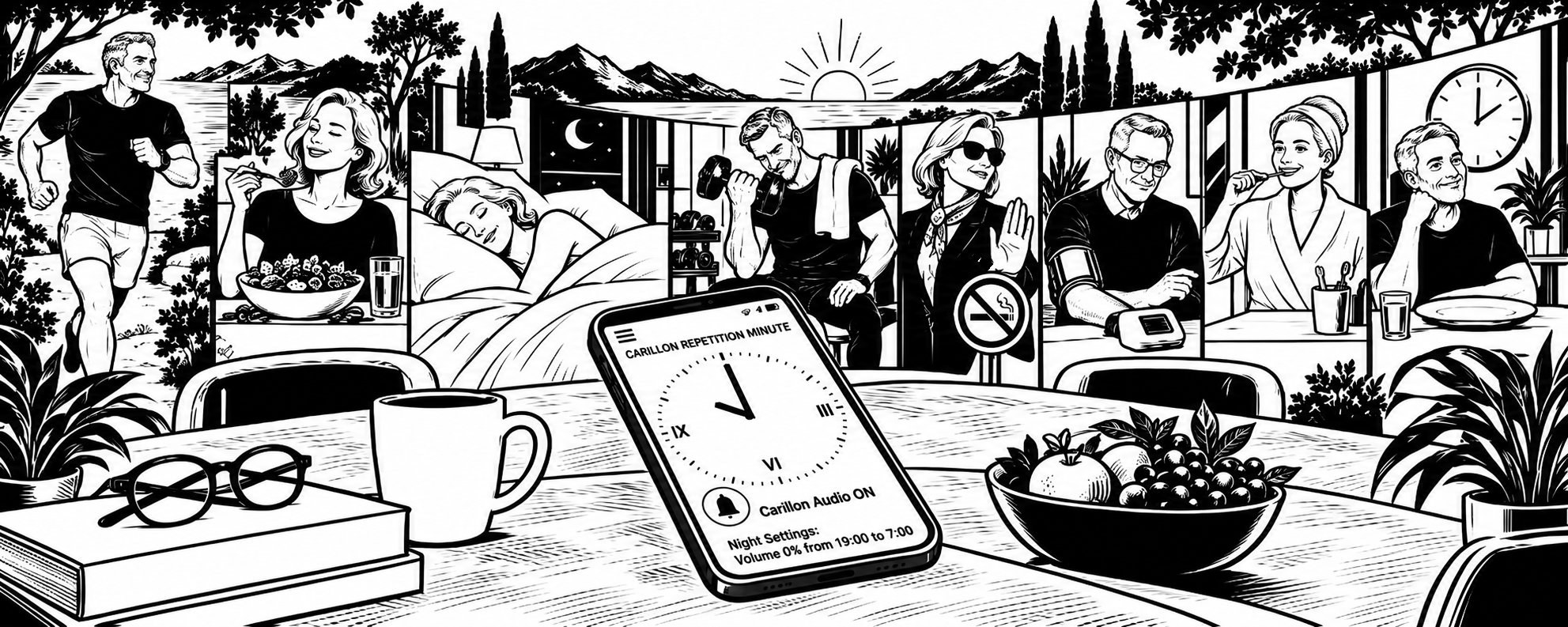
Exercise. Eat well. Sleep enough. Maintain muscle. Don't smoke. Preserve oral hygiene. Keep blood pressure, glucose and cholesterol in range. Increasingly, perhaps, restrict the hours during which we eat.
But there is another variable hiding in plain sight: when.
Human physiology is not a set of processes running at constant intensity around the clock. It is rhythmic. Hormone secretion, body temperature, alertness, metabolism and sleep all oscillate on biological clocks. This isn't wellness folklore: the 2017 Nobel Prize in Physiology or Medicine went to Jeffrey Hall, Michael Rosbash and Michael Young for discovering the molecular mechanisms controlling the circadian rhythm — the roughly 24-hour clock through which organisms anticipate day and night.[1]
We are, quite literally, built around time. And the evidence increasingly suggests that regularity itself matters.
Regularity, not just quantity
One particularly striking study analysed more than 10 million hours of accelerometer data from 60,977 UK Biobank participants. The researchers computed a Sleep Regularity Index — how consistently each person fell asleep and woke from one day to the next.
Compared with the least regular sleepers, the more regular groups had a 20–48% lower risk of all-cause mortality over the follow-up period (around 20–30% once every confounder the authors could measure was adjusted for). More remarkable still: sleep regularity was a stronger predictor of mortality than sleep duration.[2]
Observational data cannot prove that regularity causes longer life. But it raises a real possibility: perhaps the body benefits not only from getting enough hours of sleep, but from knowing when those hours are going to happen.
The same pattern appears elsewhere. "Social jetlag" is the gap between our biological clock and our social timetable — sleeping and eating at substantially different hours on working days and weekends. A 2024 systematic review and meta-analysis found that people with two hours or more of social jetlag had roughly 52% higher odds of metabolic syndrome than those with less than one hour, although the underlying evidence is heterogeneous and largely observational.[3]
Timing enters nutrition too. Time-restricted eating research asks whether concentrating food intake within a consistent daily window improves metabolic health and reinforces circadian rhythm. The animal evidence is robust; the human results are more modest and variable. It is not yet a prescription for longevity, but circadian alignment is now a serious field rather than an eccentric lifestyle theory.[4]
Meanwhile, mainstream preventive medicine has converged on the same fundamentals. The American Heart Association's Life's Essential 8 covers diet, physical activity, nicotine, sleep, weight, blood lipids, glucose and blood pressure.[5] The World Health Organization recommends 150–300 minutes of moderate aerobic activity a week, or 75–150 minutes of vigorous activity, plus muscle-strengthening on at least two days.[6]
The foundations of longevity are becoming remarkably uncontroversial. And yet the public conversation looks rather different.
The longevity stack
David Sinclair's public work on longevity ranges across fasting, diet, exercise, heat and cold exposure, supplements and emerging medical interventions.[7] His own day, as he has described it, is highly structured: up at 6:45, meditation at 6:50, exercise at 8:00, a first light meal at 14:30, the gym at 18:00, dinner at 20:00.[8]
So time is clearly present. But it appears as the container for the interventions, not as an intervention in its own right.
Bryan Johnson goes much further. His Blueprint protocol reads like a laboratory timetable: in bed at 20:30, awake naturally around 05:00, bright light on waking, exercise at 06:00, no more fluids after 16:00, wind-down at 19:30, and two or three minutes of movement every 30 minutes through the working day.[9] His 2026 morning routine alone takes 4 hours and 46 minutes.[10]
Johnson is explicit that consistency matters. His advice: pick a bedtime that allows seven to nine hours in bed, and stay within about ±30 minutes of it — weekends included.[11] That is, almost word for word, the behaviour the UK Biobank study was measuring. It may be the most time-structured longevity lifestyle on public display.
Andrew Huberman, whose podcast has one of the largest audiences in health media, comes closest to making time the intervention itself. His Daily Blueprint is organised by hours since waking: sunlight within 30–60 minutes of getting up, caffeine delayed by 90–120 minutes, exercise in the morning, lights dimmed shortly after sunset, and a wake time held to within an hour "each morning, days off included".[12] Almost nothing in it is a substance. Nearly all of it is a when.
But notice what time is doing, even here. It is the machinery for executing the protocol correctly: light now, coffee now, train now, dim the lights now, sleep now. The clock coordinates the treatments.
What if awareness of time is itself part of the treatment?
The missing habit
Most of us cannot turn our homes into clinics, and shouldn't.
We have meetings that overrun, phone calls, children, trains, dinners, and afternoons that somehow disappear. The problem is rarely that we don't know exercise is good for us or that sleep matters.
The problem is that we lose the day.
We sit down at 14:00 and suddenly it is 16:17. Lunch drifts later. Exercise gets postponed. Work invades the evening. Bedtime moves by an hour, then two. Our intentions stay perfectly healthy while their timing quietly disintegrates.
This is where routine deserves more respect than it gets. Routine is often portrayed as the enemy of spontaneity. Physiologically, it is closer to infrastructure: a reasonably stable rhythm lets sleep, movement, meals and recovery happen without a fresh act of willpower each time.
For centuries, towns, churches and mechanical clocks made time audible. From the monastery bell to the quarter chimes of Westminster, we were wired to hear the hour pass long before we could read it from a dial — a history told in The Sound We Removed From Our Lives, to which this article is the second part.
There is a simple modern equivalent: let the clock speak again. A phone can reproduce the old carillon principle — a discreet chime at each quarter-hour, and a different sequence on the hour. No notification to read. No screen to check. Nothing due.
Most of us could not say, even roughly, what we did with the last quarter of an hour. That gap is what the second half of this piece is about. The purpose isn't to make life rigid. It is almost the opposite. It restores something smartphones paradoxically took away: passive awareness of passing time.
The clock the brain builds
Something else happens after a few weeks, and it is worth describing carefully.
The brain is a predictive organ. It does not merely register events; it anticipates them, and it uses whatever temporal regularities the environment offers to do so.[13] When stimuli arrive in a rhythmic stream, neural oscillations entrain to the rhythm: responses to the expected event sharpen and reaction times fall.[14] The circadian clock the Nobel committee honoured is the grandest example of the same principle — an organism anticipating a recurring event rather than reacting to it.
Give the brain a reliable quarter-hour cue and it appears to do what it does with every other regularity: it starts to expect it. You begin to sense that the quarter is near before it strikes. You look up from the screen a moment before the sound. The chime stops being information and becomes calibration.
The laboratory evidence for entrainment concerns rhythms of seconds, not quarters of an hour, so the claim here is modest and partly personal: a regular external clock seems to sharpen the internal one. But it is a plausible mechanism, and it points to a habit no supplement can provide.
Do you remember the last quarter?
There is a second habit that the chime makes possible, and it costs one sentence.
When the quarter strikes, ask: what did I do in the last fifteen minutes? Write one line. Timestamped, on the device, nobody else's business. Fifteen minutes is short enough that the answer is still honest — nothing has been rounded up, forgotten or reinterpreted.
This matters because we are poor witnesses of our own time. When people's estimates of how long they spend on an activity are compared with contemporaneous diary records, the estimates show systematic bias and large random error.[15] We do not know where the afternoon went because we never recorded it going.
Recording changes behaviour. A meta-analysis of 138 experiments found that prompting people to monitor their progress toward a goal reliably improved attainment, and that the effect was larger when the record was physically written down.[16] In a meta-regression of 122 healthy-eating and physical-activity interventions, self-monitoring was the single technique that explained the most variation in effectiveness.[17]
A quarter-hour log is self-monitoring at its finest grain. At the end of a week you have a plain record of when you actually slept, ate, moved, worked and drifted — the raw material of regularity. Read it yourself, or hand it to an AI and ask where the day leaks. Either way, the regularity the UK Biobank study measured stops being an abstraction and becomes a document you can correct.
The bell we grew up with
And the quarter-hour may feel natural for another reason. Long before adulthood, many of us had already spent thousands of hours living by bells. School continued, in a secular form, something churches and town clocks had done for centuries: it divided the day into audible blocks and told us when one activity ended and another could begin. Across OECD countries, lessons have commonly lasted 45 to 50 minutes, with short breaks of 10 to 15 minutes between them.[18] In Germany, the familiar 45-minute school hour has a particularly precise birthday: on 22 August 1911 Prussia ordered 45-minute lessons after contemporary experiments on pupil fatigue had challenged the traditional 60-minute class.[19]
So for years of childhood, the quarter was quietly built into the architecture of the day. Forty-five minutes of attention, then a boundary; often a short break, then another beginning. The bell did something important that we hardly noticed at the time: it carried the responsibility for time. We did not have to keep asking ourselves how long we had been sitting there or when to stop. The environment told us.
Then school ended, the bells disappeared, and adult life gave that responsibility back to us. The hours remained, but many of their boundaries vanished. Work could stretch indefinitely, a screen could absorb an afternoon, lunch could drift, and forty-five minutes could become two hours before anything external reminded us that time had moved on.
It would be too strong to claim that losing the school bell caused modern time-blindness. But the underlying principle is not fanciful. Research on school breaks continues to examine how interruptions to prolonged classroom activity affect attention, and a systematic review with meta-analysis finds some evidence of benefits to attentional performance, although results are mixed and do not establish a magical 45/15 formula.[20] The interesting point here is simpler: for a large part of our formative years, time was externally structured for us. Afterwards, we were expected to structure it ourselves.
Seen that way, the quarter-hour is not an arbitrary unit invented for a productivity app. It sits at the intersection of several rhythms we already know: the old church bell, the civic clock, the school timetable and the familiar quarter, half and three-quarter divisions of the hour. A quarter-hour log simply adds memory to the chime. The sound tells you that time has passed; the log lets you say what happened while it was passing.
Perhaps that is why fifteen minutes feels small enough to remember, yet large enough to have contained something worth remembering.
What the clock can do
A quarter-hour chime will not lower LDL cholesterol. It will not build muscle, raise VO₂max or substitute for sleep. There is no clinical evidence that hearing a carillon every fifteen minutes makes anyone live longer.
But it does something much simpler. It reminds us, without demanding our attention, where we are in the day. And if regular sleep, regular movement, well-timed food and stable circadian rhythms matter for long-term health, then the humble clock deserves a small place beside the wearable, the supplement bottle and the running shoes.
While longevity is usually presented as a battle against biological time, perhaps part of it is simply learning to notice time again.