The previous article, The Knowledge the Regulator Still Wants, applied the argument to pharmaceutical companies, where tacit knowledge is most tightly regulated and most expensive to lose. This third and last article of the series turns to the Swiss public sector, where a demographic wave and a technological one arrive together, and where the Confederation has already written the right objective into its own personnel strategy.
Two waves at once
Over the next ten years, around one third of Federal Administration employees will reach retirement age, against a little under a fifth for the Swiss workforce as a whole. That is the opening finding of the Swiss Federal Audit Office's 2025 horizontal audit of personnel measures, which also observed that implementation is highly decentralised and uneven between departments.[1] The Federal Council's personnel strategy for 2024 to 2027 is built on exactly this problem, "demographic change in a digital working environment", and rests on four pillars, one of which is maintaining and transferring knowledge, another ensuring the next generation and offering prospects, with internal mobility among its measures.[2]
The cantons and the public enterprises are no better placed. Since 2019, new entrants to the labour market have no longer replaced the public employees who retire; several federal offices face replacement needs of 40 to 47 percent by 2034, and in some cantonal directorates close to half the staff are over fifty.[3] Swiss Federal Railways expects 8,000 employees, a quarter of its workforce, to reach retirement age by 2035; in Basel, the municipal transport company expects a third of its staff to retire by 2030.[4]
The second wave is artificial intelligence. In March 2025 the Federal Council adopted a strategy for the use of AI systems within the Federal Administration;[5] in December 2025 it approved an implementation plan that includes a handbook on AI systems for employees and moves the national AI competence network to the Federal Chancellery.[6] In parallel, the Federal Department of Justice and Police is to present draft AI legislation for consultation by the end of 2026.[7] In Geneva, the Department of Institutions and Digital Affairs commissioned a multidisciplinary study from the University of Geneva on AI and digital sovereignty; published in September 2026, its twenty-two recommendations begin with controlling the pace and extent of AI deployment in the administration, starting from public-policy objectives rather than from the technology.[8][9] The Confederation, cantons, cities and communes have, since 2024, a joint strategy for the digital administration.[10]
Two things follow. Public employers will lose a great deal of experience in a short time, and they will simultaneously be redrawing the tasks that remain. Experienced employees will find their responsibilities changing while the institution has less capacity than ever to notice what they know.
What a public servant knows
Decades ago, Michael Lipsky showed that public policy is, in the end, what front-line officials do with their discretion: the clerk at the counter, the inspector, the caseworker.[11] That discretion is knowledge, and almost none of it is written down. The employee in a cantonal tax office knows which forms small businesses get wrong and why. The hospital administrator knows where appointments actually break down. The planner in public transport knows which timetable change will generate complaints. The teacher knows which part of the curriculum no textbook explains well.
Research on ageing workforces finds that organisations usually discover what a departing expert knew after the departure,[12] and the Confederation's own strategy acknowledges the risk by making knowledge transfer a pillar. But transfer presupposes that the knowledge has been recognised, first of all by the person who holds it. After twenty years in the same administration, this knowledge feels ordinary to its owner.
The first article of this series described how a private quarter-hour logbook, kept over several months, lets an employee see which problems keep arriving at their desk, which they solve with unusual ease, and which interests persist. The mechanism does not change in a public setting. What changes is the range of destinations for what it reveals.
Three destinations, in this order
Internal mobility. The federal personnel strategy already names it. An employee who can articulate what they know is far easier to move than one who cannot, and far more likely to apply. The constraint the Audit Office identified, decentralised and uneven implementation, is partly an information problem: offices do not know what their own people could do elsewhere. A voluntary capability summary, written by the employee from months of private reflection, is the cheapest instrument there is for closing that gap.
A redesigned role in place. As AI takes over routine casework, the public employees who understand the exceptions become the people who must supervise, train and correct the systems. The digital-government literature is clear that digital transformation of an administration is organisational before it is technical, and depends on the staff who know the processes.[13] The Geneva study's call to keep the administration in control of the pace of deployment is, in practice, a call for exactly these people.
An independent activity. Some employees will recognise, in their logbook, the shape of a service nobody offers: a tool explaining administrative requirements to small firms, a non-clinical logistics service for hospitals, a specialised teaching resource. Research on transitions from public employment to entrepreneurship shows they are rarer than from the private sector but real, and shaped by tenure, professional history and the organisational context the person leaves.[14] The OECD's review of public employment argues that public services need more permeable careers in both directions, and treats mobility out of and back into the public sector as a sign of health, not disloyalty.[15]
An HR department should present the three in that order. A programme that reads as encouragement to leave will not be sponsored by a cantonal administration and should not be; a programme that helps employees see their own capabilities, and then lets them choose, serves the institution first.
Switzerland already supports the third path
For employees who do take the third path, the support structures exist. Innosuisse's Initial Coaching gives founders of an innovative, science-based project a voucher worth up to CHF 10,000 for accredited coaching over up to twelve months, as the entry point to its Core Coaching programme.[16] In Geneva, FONGIT, supported by the State, runs innovation-initiation and start-up programmes.[17] Innovaud connects Vaud entrepreneurs with coaching, financing and research partners.[18] Basel Area Business & Innovation acts for the two Basel cantons and Jura;[19] in Valais, The Ark Foundation plays the same role from Sion.[20] Comparable structures exist in every region.
These organisations do not finance career transitions and most are reserved for technologically innovative or scalable projects. What they show is that Switzerland already invests in turning promising ideas into businesses; the missing stage is upstream, at the point where an experienced public employee realises that twenty years of casework contains such an idea.
Boundaries a public employer must draw
A programme of this kind inside a public administration needs clearer boundaries than in a company.
The logbook is personal, stays on the employee's own device and is never collected. Participation, and any later conversation with a career adviser, is voluntary. Nothing in the logbook replaces official records, and nothing confidential belongs in it.
Secondary employment and the use of non-public information are governed by federal and cantonal personnel law. The Federal Administration's code of conduct of August 2024 requires paid secondary activities to be declared and forbids the use of unpublished information obtained in the course of duty.[21] A Federal Audit Office review of secondary employment in the Federal Administration published in March 2026 found inconsistencies in reporting and authorisation practice.[22] Personal reflection on one's own capabilities is lawful and healthy; the commercial use of institutional knowledge, privileged information or public resources is not, and a programme must say so at the outset.
Evaluation should be honest. A large randomised trial of workplace wellness programmes found better self-reported behaviours but no measurable effect on absenteeism, tenure or performance after eighteen months;[23] a public-sector pilot should measure what it actually aims at: career clarity, internal applications and moves, participation in training, and knowledge retained through a retirement wave. The literature on public-sector corporate entrepreneurship suggests that such initiatives succeed where management gives them structure, resources and tolerance for small failures,[24] which is the same lesson the private sector learned.
The instrument
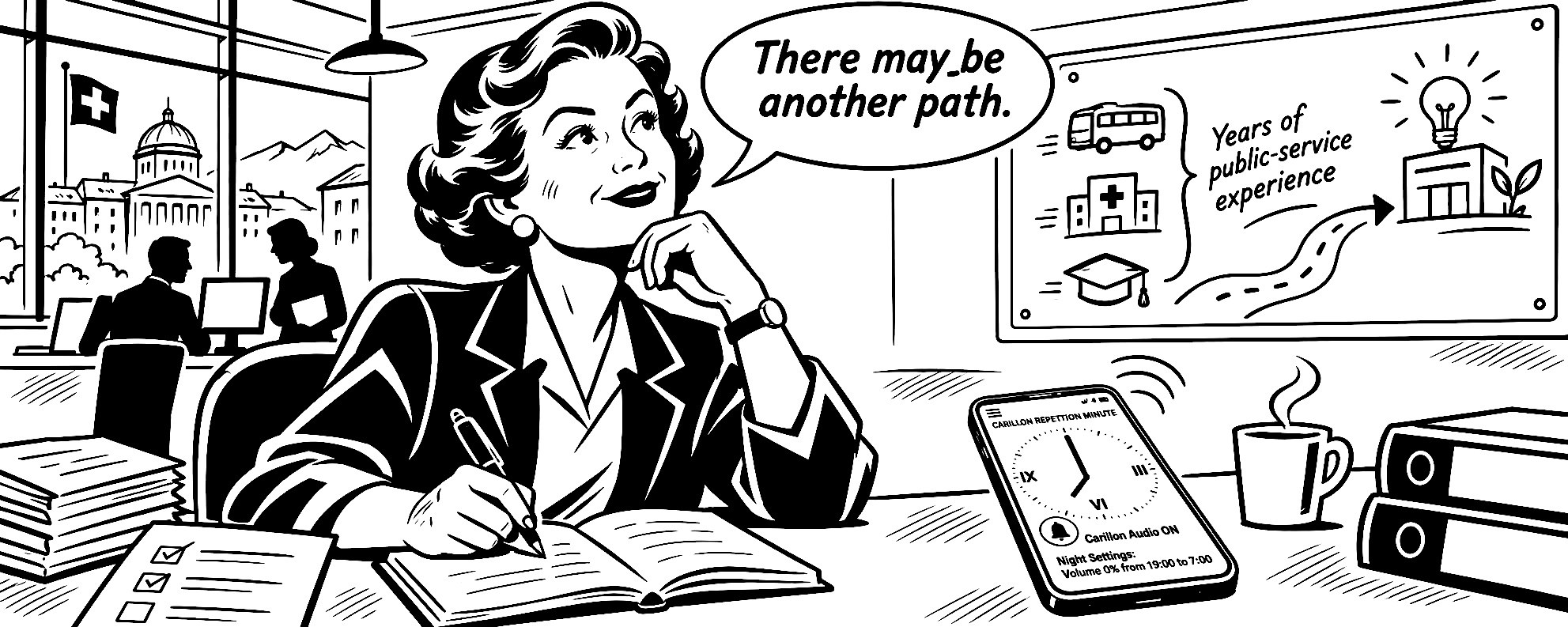
Carillon Repetition Minute offers the personal part of such a programme. Its quarter-hour chime arrives as a notification; one tap opens a private logbook; one sentence, typed or spoken, records what the interval held. Over a season, the entries show a public servant what their work actually consists of, which is the first thing an administration facing a retirement wave needs its people to know, and the first thing those people need to know about themselves.
Switzerland already knows how to turn ideas into enterprises and how to move people between offices. What it lacks is a quiet, private way for experienced public employees to discover what they have to offer before the moment they are asked to leave or to change.
This closes the series. The general case, the pharmaceutical case and the public-sector case rest on the same proposition: artificial intelligence takes the routine part of a job and leaves the tacit part, and a quarter-hour of attention, kept over months, is how a person finds out what that part is worth.