The previous article, The Employee AI Cannot See, set out the general case: artificial intelligence absorbs the routine part of a job and leaves the tacit part, and a quarter-hour logbook is one way for an employee to find out what that part is worth. This second article of three takes the argument into the industry where tacit knowledge is most expensive to lose and most tightly regulated: pharmaceuticals.
An industry built on what it cannot write down
Pharmaceuticals is Switzerland's largest export sector. The research-based companies employ some 46,000 people directly and, along their value chains, support around 280,000 jobs;[1] across Europe the industry employs close to 900,000.[2] It is also an industry in motion. In 2022 Novartis announced a restructuring of up to 8,000 positions, including 680 in its development organisation, 440 of them in Switzerland, in functions such as regulatory affairs, analytics and quality assurance.[3] Industry-wide, biopharma layoffs rose by almost half in 2025 to some 42,700 people, and 2026 has continued at a comparable pace, with corporate restructuring the most common stated reason.[4]
What makes this industry different is how much of its knowledge is tacit. An experienced scientist knows why certain experimental approaches keep failing. A manufacturing specialist recognises a process drift before it shows in the batch record. A clinical operations manager knows which procedures stall across trial sites, and why. A regulatory professional remembers how a question from an agency was answered a decade ago, and what the agency has asked since.
The industry knows this about itself. A systematic review of 137 studies found knowledge management treated as a core concern of pharmaceutical research, and found a gap between what academics study and what regulators expect.[5] ICH Q10, the guideline that defines the pharmaceutical quality system, names knowledge management, alongside quality risk management, as one of the two enablers of that system.[6] ICH Q12 extends the expectation across the product lifecycle.[7] When the industry's own engineering society published its first knowledge-management guide in 2021, it placed its emphasis squarely on tacit knowledge, the know-how and know-why, and observed that the industry had been slow to act on Q10's expectation.[8]
Knowledge that is not written down leaves with the person. The management literature calls the conversion of tacit to explicit knowledge the hardest step of all, one that needs time, conversation and apprenticeship rather than a form.[9] Research on ageing workforces has shown that organisations usually notice what a departing expert knew only after the departure.[10] And employees themselves are poor judges of how specific and how valuable their own expertise is.[11]
A job may become redundant without the knowledge of the person occupying it becoming redundant.
What AI is actually taking over
Artificial intelligence enters pharmaceutical work from several directions at once. In research, structure prediction has removed years of effort from protein work,[12] and self-driving laboratories now plan, run and interpret rounds of experiments with little human intervention.[13] In development and regulatory affairs, language models draft, compile and translate documentation. In manufacturing, process analytics watch continuously what operators once watched by eye.
The regulators have responded with a consistent message: AI may support every phase of the medicinal product lifecycle, but a human remains accountable for the result. The European Medicines Agency's 2024 reflection paper calls for a human-centric approach throughout, and requires quality review of any AI-generated text in product information.[14] The US Food and Drug Administration's 2025 draft guidance sets out a seven-step credibility framework in which the first and hardest steps, defining the question of interest and the context of use, require exactly the judgment that comes from experience.[15] ICH Q9's 2023 revision, on quality risk management, insists on the same point from the other side: it asks companies to manage the subjectivity of risk assessment, which means knowing who in the building actually understands the process.[16]
In other words, the regulators are asking for the employee AI cannot see. The question for a pharmaceutical HR department is whether it can see that employee before a restructuring plan is signed.
Capabilities that assessments overlook
After years in the same organisation, specialised abilities seem ordinary to the people who hold them. An employee who routinely resolves friction between departments may not recognise an exceptional aptitude for process improvement. Someone who regularly explains complex science to non-scientists may overlook a rare ability to connect technical specialists with operational teams. These capabilities do not appear on an org chart, in a job description or in a competency matrix.
The previous article explained how a quarter-hour logbook, kept privately over several months, surfaces such patterns: which problems colleagues keep bringing, which difficulties are resolved with unusual ease, which interests persist. The mechanism is the same in a laboratory, a clinical operations office or a packaging line. What differs in pharma is the value of what the logbook reveals, and the number of places where it could be redeployed.
Where new responsibilities could emerge
Consider five hypothetical examples.
Research and discovery. A laboratory scientist whose bench work is increasingly automated holds years of experience interpreting unexpected results. That knowledge could support the evaluation of AI-generated hypotheses and the collaboration between wet-lab and computational teams that every self-driving laboratory still requires.
Clinical development. An employee who has coordinated international trials knows the recurring causes of delay in site activation and study administration. That knowledge could redesign clinical operations workflows, or train the models now proposed to predict enrolment.
Manufacturing and quality. A production specialist with years of practical knowledge of deviations, equipment limits and shift handovers is precisely what a technology transfer needs; the industry's own guidance on technology transfer describes the transfer of knowledge, not of documents, as its central task.[17] The same person could lead the validation of automated systems that will otherwise learn from data that nobody understands.
Regulatory affairs. A professional familiar with the history of submissions could build, validate and govern the AI-assisted documentation processes that the EMA and FDA now expect to be supervised.
Medical affairs and corporate services. Employees who have long coordinated scientific, administrative and commercial functions are often the first to see the need for a new internal service, a training programme or a better way of transferring knowledge between sites.
In each case the institution keeps the benefit of accumulated expertise while the employee moves to a different responsibility. Work-related reflection is associated with exactly this kind of job crafting and with innovative behaviour,[18] and the opportunity is not limited to retraining people for predefined posts. It includes helping them recognise and propose responsibilities that do not yet formally exist.
From overlooked expertise to internal innovation
Several large pharmaceutical groups run innovation programmes or corporate venture structures able to evaluate ideas from employees. Burgelman's foundational study of internal corporate venturing showed that such initiatives originate among operational employees and succeed only where management structures recognise and sponsor them.[19] Research on temporary internal assignments shows how employees build new competencies, relationships and professional identities that their existing posts cannot accommodate.[20] A recent eighteen-month study of intrapreneurs inside an internal venturing programme adds the warning: where companies leave the tension between entrepreneurial independence and corporate expectations unmanaged, the individuals end up worse off.[21]
An experienced employee might therefore propose a new operational service, a digital tool, a training initiative or a better method of moving knowledge between sites. Such a proposal could be evaluated through the existing innovation programme, supported by technical mentorship, or run as a limited internal pilot. The willingness to make such proposals depends on psychological safety: people speak up about what they know only where they expect to be heard rather than penalised.[22]
Not every proposal will justify investment, and not every restructuring can avoid redundancies. But an organisation that systematically overlooks employee-generated opportunities loses, with each departure, knowledge that its own quality system tells it to preserve.
A role for HR and corporate wellness
HR departments could complement conventional workforce planning with a voluntary programme that encourages time awareness, personal reflection and professional realignment, run over several months and separate from performance management.
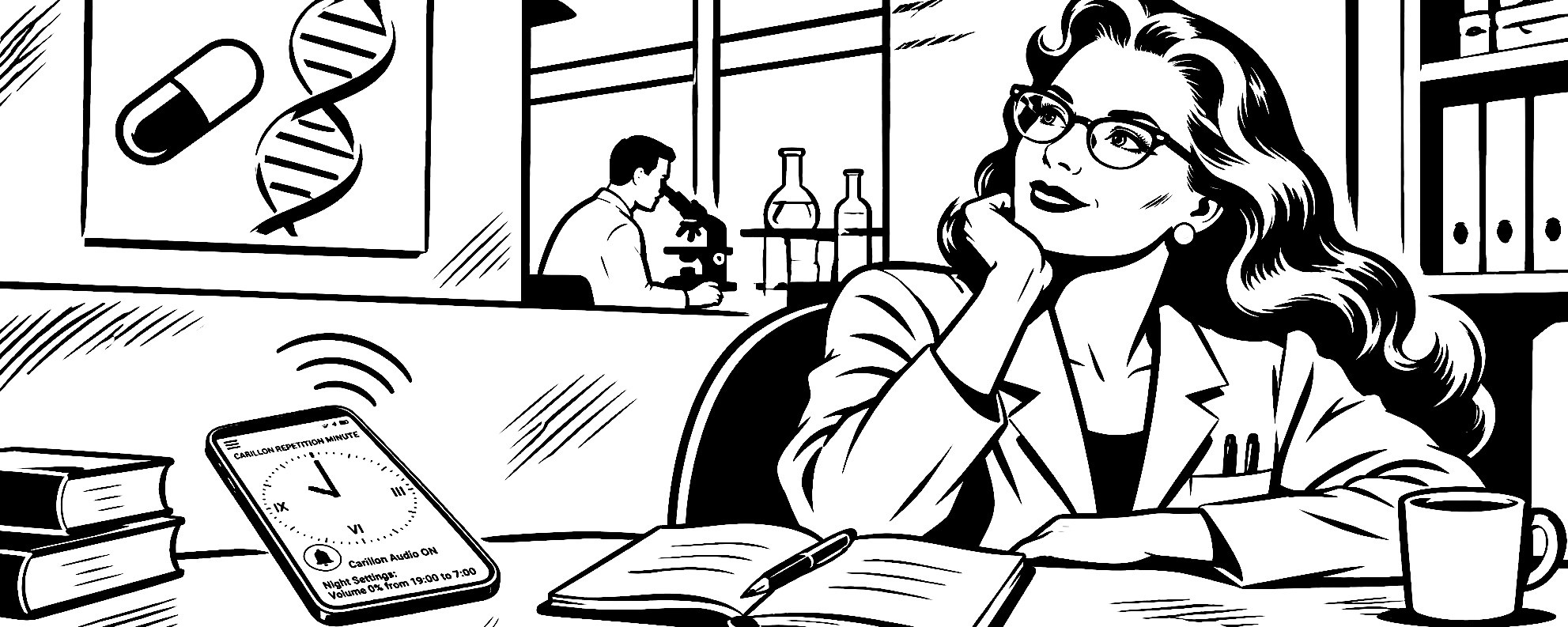
Carillon Repetition Minute offers one instrument for the personal part. Its quarter-hour chime arrives as a notification, one tap opens a private logbook, and a sentence records what the interval held. Over a season, these entries let an employee recognise capabilities that were hard to articulate.
Three boundaries matter in this industry. The logbook is personal and stays on the employee's own device; it must not replace regulated scientific, clinical or quality records, and it must not hold protected institutional information. Participation and any later disclosure of ambitions remain voluntary. And whatever an employee chooses to share, a summary of capabilities, a project idea, a request for coaching, enters the HR process on the employee's initiative, not by extraction.
Employees who wish to explore new responsibilities could then receive career coaching or access to internal mobility and innovation programmes. The business effects should be measured rather than assumed: a large randomised trial of workplace wellness programmes found better self-reported behaviours but no effect on absenteeism, tenure or performance after eighteen months,[23] and a pharmaceutical pilot should track what matters here, career clarity, voluntary proposals, internal redeployments, and knowledge retained through a restructuring. The classic account of knowledge management in this industry notes that its successes have come from connecting people and content, not from systems alone.[24] A personal logbook is the smallest possible version of that connection.
Before eliminating a position, a pharmaceutical company should ask whether the person occupying it holds the knowledge required to create its next capability.
The third article turns to the public sector in Switzerland, where a demographic wave and a technological one arrive at the same time.