The previous article, A New Art: The Minute Repeater That Writes, looked at the object itself and at why its pieces form a new art. This one turns to the people who may need it most: employees whose jobs are being redrawn by artificial intelligence, and the HR managers who decide what becomes of them.
When the job changes, what happens to the person?
Artificial intelligence is transforming professional activity faster than most employees can reconsider their careers.
The International Labour Organisation estimates that one worker in four worldwide holds an occupation exposed to generative AI, while stressing that the transformation of existing jobs remains more likely than their disappearance.[1] An earlier study of the US workforce reached a similar conclusion from the other direction: most occupations contain at least some tasks a language model can take over, and very few consist of nothing else.[2]
The distinction matters. A position may become less necessary without the person occupying it having lost professional value.
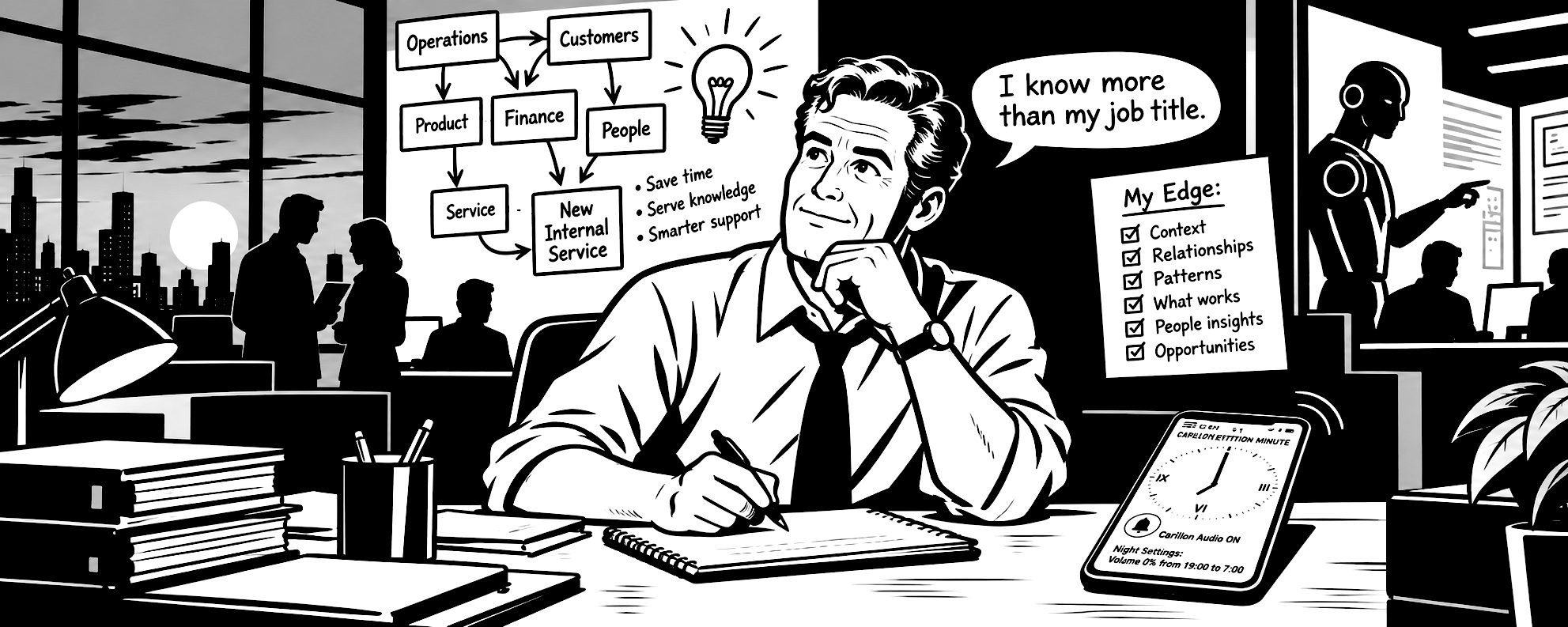
Field evidence adds a twist. When customer-support agents were given an AI assistant, the largest productivity gains went to the least experienced; the model had, in effect, absorbed the routine part of what the veterans knew.[3] What the model did not absorb is the part that was never written down: why a procedure exists, which difficulties return every quarter, which colleague to call, how a decision is actually taken. Polanyi called this tacit knowledge and summed it up in a sentence: we know more than we can tell.[4] Economists later gave the difficulty a name, Polanyi's paradox, to explain why so much skilled work resists automation.[5] Recent organisation studies place this embodied, experience-bound expertise at the centre of skilled professional activity,[6] and strategic management research treats firm-specific human capital as a source of competitive advantage, while noting that employees and their employers rarely value it the same way.[7]
When an organisation restructures, these qualities remain invisible: to the HR manager reading an org chart, and often to the employees themselves. Recognising one's professional value takes more than an occasional career assessment. It takes a sustained habit of reflection.
What a personal logbook can reveal
Modern working days are fragmented by meetings, messages, administrative obligations and interruptions. An employee can be continuously occupied without understanding how the time contributes to anything longer than the day. A meta-analysis of time management found it associated with performance and, more strongly, with well-being, in particular life satisfaction and lower distress.[8]
Journaling adds a dimension that a calendar cannot: the chance to reconsider experience rather than merely record activity. Writing about an experience organises it; the founding studies of expressive writing showed measurable effects from a few short sessions.[9] In a field experiment at a European bank, employees who could look back at their earlier written reflections kept reflecting longer and became more aware of learning opportunities at work.[10] Fifteen minutes of written reflection at the end of a training day improved later performance more than the same time spent on additional practice.[11]
The accumulated record is what matters. An isolated entry says little more than what an ordinary task was. After several months, many such entries reveal recurring achievements, recurring problems, strengths and interests. Keeping track of progress improves the odds of reaching a goal, and more so when the progress is physically recorded.[12] A randomised trial with 600 Japanese workers found that a smartphone diary of daily achievements produced a small but significant rise in work engagement within two weeks.[13] The tone of the entries matters too: three diary studies found that reflecting on the positive side of one's work improved mood beyond the effect of simply switching off.[14]
Read back over a season, such a logbook shows an employee how often colleagues rely on a particular expertise, how much satisfaction comes from resolving certain difficulties, and which overlooked capability could carry a different career. Research on career self-management supports the mechanism: in an intervention with 205 employees, strengthening self-knowledge, career goals and planning predicted later career-management behaviour and satisfaction.[15] In a two-wave study of 842 Finnish workers, proactively shaping one's own career was associated with higher engagement and lower burnout.[16]
Professional confidence grows from a clearer understanding of what one already knows.
A chime, a tap, a sentence
Carillon Repetition Minute offers a simple way of building this habit.
Inspired by the quarter-hour strikes of a mechanical minute repeater, the application makes the passage of time perceptible through a chime or a vibration. In the full version, each strike arrives as a notification, and one tap opens the logbook. The user answers with a sentence, typed or spoken, describing the preceding interval; a light notation opens a task, records progress and names the next step. Scientists studying daily life have used signal-prompted entries of this kind since the 1970s, because a note written on the spot is more reliable than a memory reconstructed at night.[17]
The method asks three questions at each strike: what was this quarter for, what was learned, what deserves attention next. The purpose is not to monitor productivity every fifteen minutes but to create recurring opportunities to regain perspective. Over time, the broader questions follow on their own: which capabilities keep showing up, which priorities, which ambitions.
Two design choices suit a workplace. The prompts stay discreet and optional, since unwanted interruptions raise stress and perceived time pressure.[18] And the application keeps no streak, because missing a single opportunity does not derail a forming habit.[19]
The journal stays on the user's own device. Reflections about one's own future remain private, which is what makes them honest.
A new dimension for corporate wellness
HR departments could add voluntary time-awareness and reflective-journaling practices to the well-being and professional-development programmes they already run. A programme extending over several months could combine personal reflection with optional career coaching, skills development and information about internal opportunities.
For employees whose responsibilities are changing, the objective would be to develop enough self-knowledge and confidence to consider alternatives before those alternatives become urgent. The research on proactive behaviour at work points the same way: people act on their situation when they believe they can, have a reason to, and have the energy to,[20] and self-knowledge is the first of the three. Employees have long been shown to reshape the boundaries of their own jobs,[21] work-related reflection is associated with innovative behaviour and with this kind of job crafting,[22] and an intervention that encouraged employees to reshape their work improved their attitude to organisational change and reduced exhaustion.[23]
For employers, the benefit would be indirect: employees who understand their capabilities are better placed to adapt, to propose improvements and to take on new responsibilities. None of this should be assumed. A large randomised trial of workplace wellness programmes found better self-reported health behaviours but no measurable gain in absenteeism, tenure or job performance after eighteen months.[24] The effects of a programme built around Carillon would need the same scrutiny.
The next two articles take this argument into two settings where the stakes are highest: the pharmaceutical industry, where decades of regulatory and process knowledge sit inside roles that automation is redrawing, and the Swiss public sector, where a demographic wave and a technological one arrive together.
What a modest reflective practice offers, and conventional productivity tools rarely do, is the chance for a person to reconsider their relationship with their work. Before employees can propose a different professional future, they first need the time and the perspective to recognise what they are already capable of becoming.