
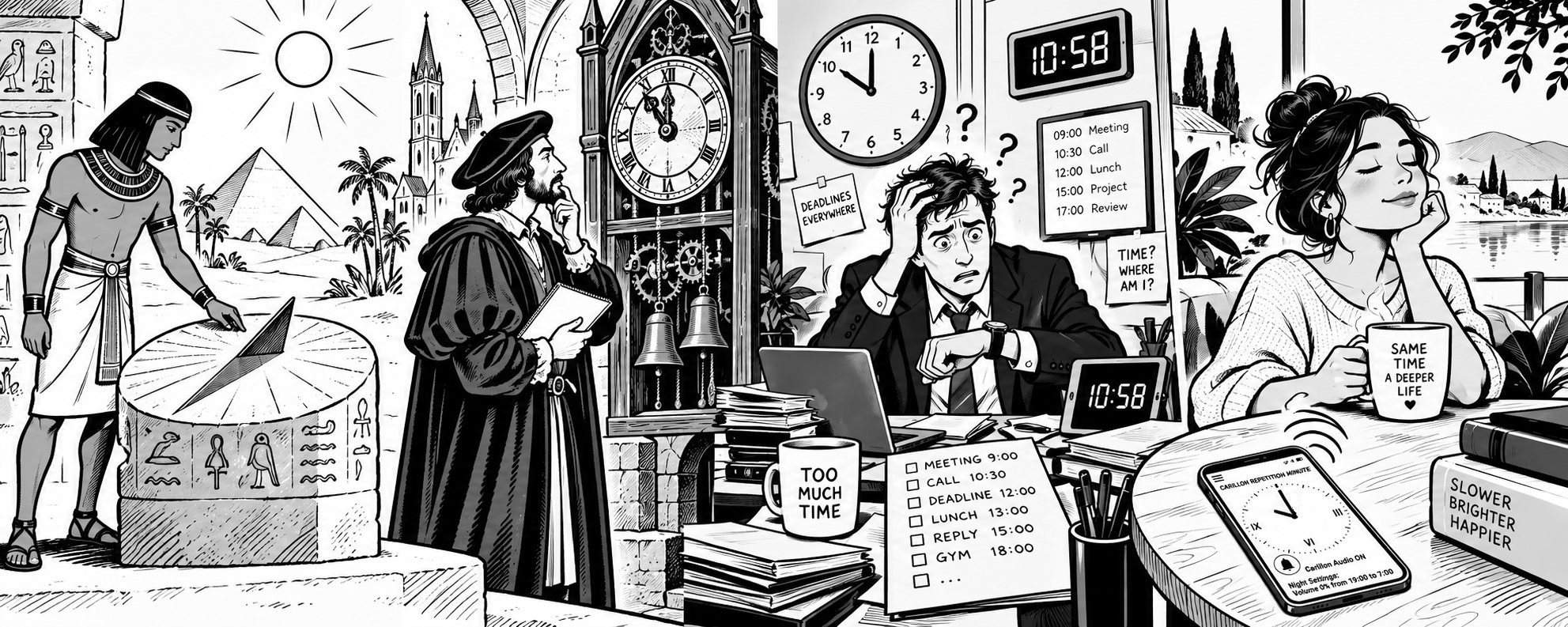
This article will take you only a few minutes to read, comfortably less than a quarter of an hour. When you reach the end, you will know exactly where those minutes went. Now try to remember the quarter-hour before you started reading.
What did you do with it?
For most of us, that is surprisingly difficult to answer. We have never possessed more accurate clocks, yet we routinely let pieces of the day disappear without noticing them. Not because we waste every minute, but because modern time has become something we usually notice only when we choose to look.
For centuries, societies had a remarkably simple solution: they made the passage of time audible.
The idea of dividing day and night is ancient. Egyptians were using a system of twelve daylight and twelve night hours thousands of years ago, assisted by stars, shadow clocks and water clocks.[1] But those hours varied with the seasons, and ordinary life did not yet revolve around knowing that it was precisely 10:15.
The more interesting story begins in medieval Europe, when time progressively acquired not only measurement, but meaning.
When an hour meant something
By around AD 530, the Rule of Saint Benedict had organised monastic life around the canonical hours: Matins, Lauds, Prime, Terce, Sext, None, Vespers and Compline.[2] Work, meals, rest, Mass and prayer consequently belonged to a rhythm rather than flowing into one uninterrupted day.
The bell made that rhythm possible. It could summon an entire community without requiring anyone to consult a clock. As church bells grew larger and their sound travelled beyond monastery walls, the same signals became part of everyday life in surrounding villages and towns.
The bells' role became surprisingly sophisticated. Studying fourteenth-century Catalonia, historian Jeffrey Bowman found bells announcing hours and prayers, Masses and funerals, celebrations and emergencies. They effectively helped "choreograph" communal behaviour through time and space.[3]
The bell, in other words, was an early information network. Its meaning depended on when and how it rang.
This helps explain why the first European mechanical clocks were so closely associated with bells. Our vocabulary preserves the connection: English clock, French cloche, Dutch klok and German Glocke belong to a linguistic family associated with bells.[4] Early clocks did not necessarily even need a dial. If the mechanism could strike a bell at the correct moment, it had already performed its essential function.
It is also clear what problem they solved. A sundial was useless at night and water clocks had practical limitations, while monasteries still needed to keep their nocturnal offices. Mechanical timekeeping offered a solution.[4]
When the hour acquired quarters
From the fourteenth century, public mechanical clocks spread through European cities, and the system of 24 equal hours became increasingly practical.[5] Time could now coordinate markets, work, religious services and civic life independently of the changing length of daylight.
But an hour is a long interval in which to disappear.
Clockmakers therefore began subdividing audible time, and the quarter-hour proved particularly convenient. Sixty minutes divided into four creates an intuitive progression: quarter past, half past, quarter to, then the new hour.
By the seventeenth century the idea was well established and sometimes surprisingly elaborate. A German clock attributed to Johann Sayler around 1640, now in the British Museum, contains separate mechanisms for striking the hour and quarter-hour — and another for sounding the half-quarter every seven and a half minutes.[6]
Then the quarters acquired different sounds.
In 1793, Great St Mary's in Cambridge introduced the musical sequence that became known as the Cambridge Chimes.[7] One phrase marked the first quarter, two the half-hour, three the third quarter and four the completion of the hour. The pattern was later selected for the great clock at the Palace of Westminster, whose bells entered service in 1859.[8] In the Low Countries, the same instinct had gone further still: the carillon, a tower of tuned bells played from a keyboard, turned the passing of time into music.
The Westminster Quarters became one of the world's most recognisable ways of expressing time without showing it. From 1923, the BBC broadcast Big Ben's chimes, extending audible public time from the radius of a bell tower to millions of homes.[9]
And that is the clever part. A clock face tells you the time when you decide to look at it. A quarter chime reaches you while you are doing something else. You remain absorbed in your work, conversation, book or walk, but somewhere in the background you know where you are within the hour.
The clock became perfect — and then went silent
Today, the smartphone in our pocket keeps time with a precision medieval clockmakers could scarcely have imagined. Yet for most of the day it tells us nothing about the passage of time unless we ask.
Instead, it interrupts us for messages, news, emails, social media and appointments. We have built a device extraordinarily good at demanding our attention while abandoning one of the gentlest functions of the old clock: making time perceptible without requiring attention.
An alarm demands action. A notification demands attention. A chime demands neither. It simply places a small landmark in the day.
And this is where an old idea suddenly feels very modern.
A phone can make the quarters audible again: a discreet chime at the quarter, another at the half, another at three-quarters, then the hour. There is nothing to unlock, read, dismiss or obey. The sound arrives, locates you gently within the hour and disappears. You continue whatever you were doing, only a little more conscious of the day moving with you.
For thousands of years we kept refining our relationship with time. The Egyptians divided the day; medieval communities gave its hours purpose; mechanical clocks made those hours regular; quarter striking made their passage audible; and the carillon turned that passage into music.
Then we put the most sophisticated clock ever made into everyone's pocket, and made it silent.
You have now spent a few minutes reading this, and you know where they went. Think again about the quarter-hour before you began.
That small difference is the whole idea.
Chimes cannot give us more time. They can simply help us be there while we have it.